
Third Field Season
October 25 - December 25
Summary list of activities
Last treatments and the final documentation.
During the third operational field season, activities focused on continuing the conservation assessments, carrying out application tests and updating the documentation systems required for monitoring the tombs of Hegra. The season began with organisational work, a review of the final report from the second off-season, and the planning of new on-site operations. Inspections were also carried out using scaffolding and a lifting platform, allowing access to hard-to-reach areas and enabling checks on the condition of the upper surfaces of the monuments. In parallel, the data collected during the tests were transferred and integrated into the geodatabase, together with the processing of the new mortar samples developed in collaboration with Mapei.
Diagnostic investigations continued the work of previous seasons through the analysis of samples and the evaluation of laboratory reports. The results were reviewed with the scientific consultants and compiled within the interpretative reports prepared by Professor M. Matteini, supporting the definition of the most suitable interventions to be applied in the test areas.
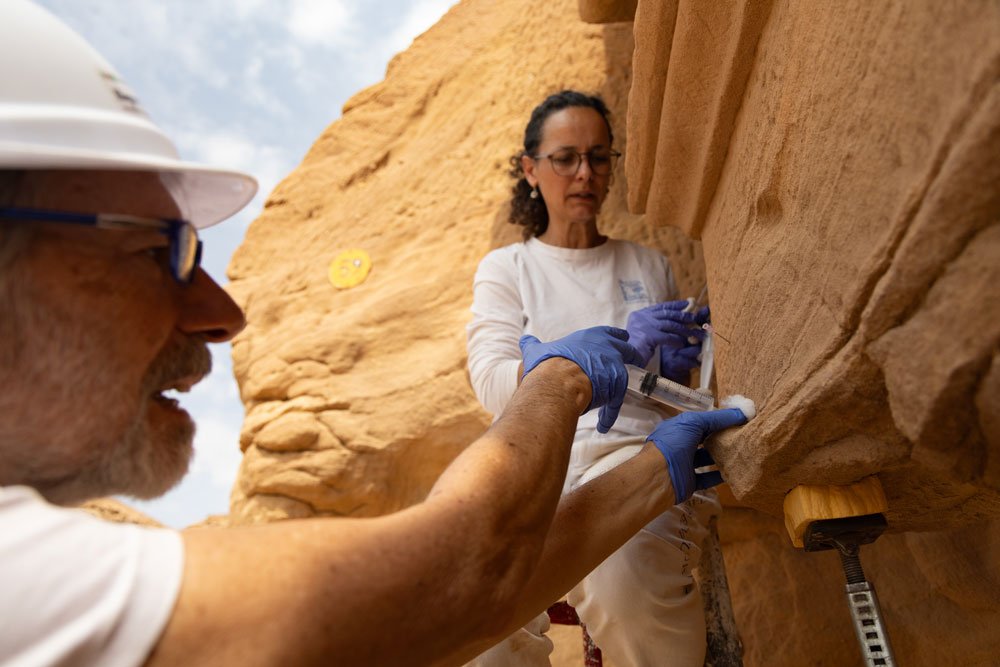
Conservation activities included the execution and verification of grouting interventions in the sample areas, as well as the testing of consolidation systems based on basalt-fibre pins, accompanied by updated technical documentation. Post-intervention monitoring was carried out using a colourimeter, thermal camera and contact sponge absorption tests, in order to assess the long-term effectiveness of the treatments. Joint inspections by the RCU and Estia teams made it possible to verify the results directly on site.
Environmental monitoring included targeted checks with a thermal camera and the download of the data recorded by the Wild Camera, which are essential for understanding microclimatic variations that influence the conservation of stone surfaces.
In parallel, work continued on processing the 3D survey data. Geogrà worked on finalising the orthophotos through full processing of the images acquired by drone, in continuity with the activities carried out during previous seasons.
The communication plan supported the entire season through ongoing exchanges between Estia and RCU, website updates and audiovisual production activities. Filming and interviews for the project’s final documentary were carried out during the season, along with the organisation and recording of the interview dedicated to the AlBanat virtual tour within the Tapestry project coordinated by CyArk.
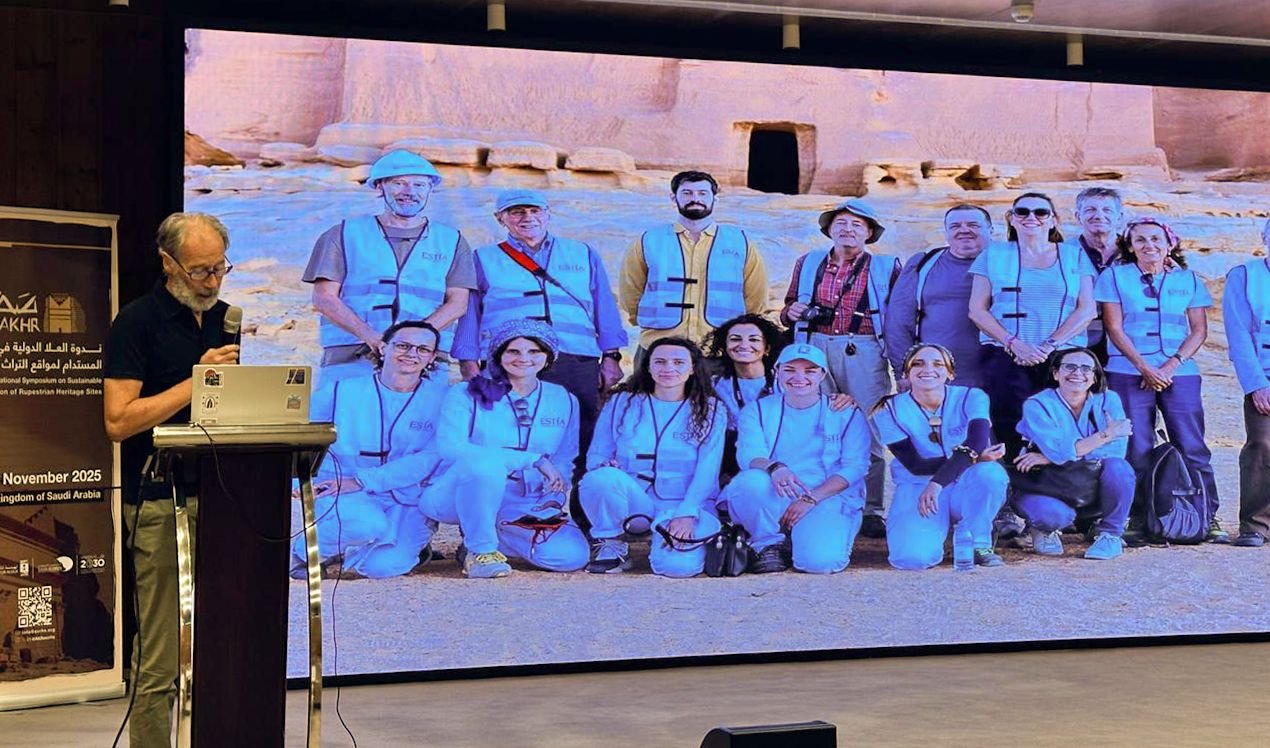
Lastly, the project was represented at numerous international events, including the Stone 2025 – 15th International Congress on the Deterioration and Conservation of Stone in Paris, the AlUla International Symposium on Regenerative Heritage, the RCU’s autumn “Thursday Night Lecture Series”, and the International Symposium on Sustainable Conservation of Rupestrian Heritage. These meetings provided opportunities to share the latest results of the “Hegra Conservation Project” and to present the evolution of the conservation strategies developed during the third operational season.