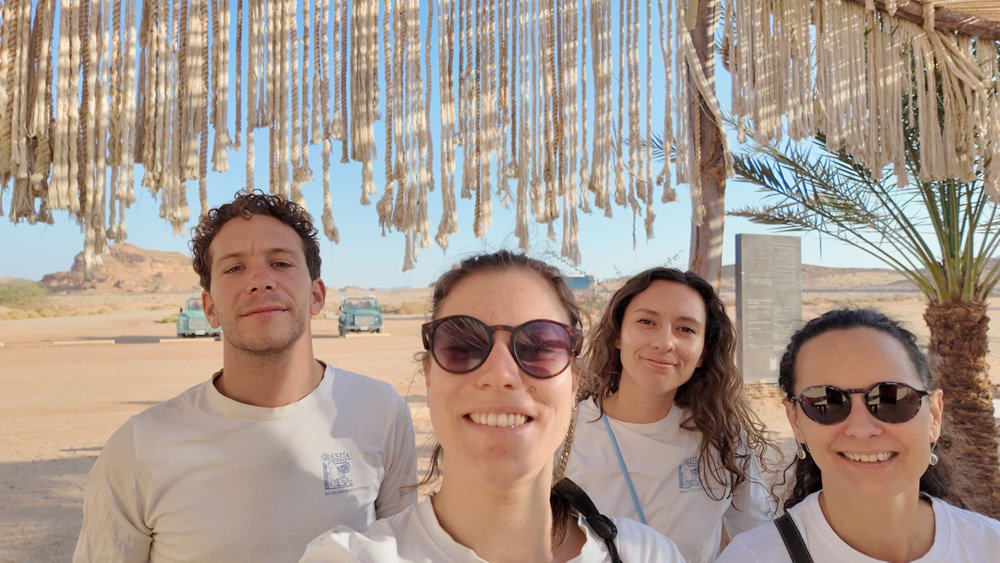
Twenty-fourth month
From Off-Season Analysis to On-Site Action
As we step into the first month of this final field season, we return to Hegra carrying the momentum of the past months spent working from Italy. During the second off-season, much of our time was dedicated to processing the extensive dataset collected during the second field campaign—organising measurements, mapping completed conservation operations, and transferring everything into the GIS database. Now, as we look at the site with fresh eyes, the results of that effort allowed us to rebuild a clear, comprehensive picture of the selected areas. While we continue testing on-site other conservation phases, these preliminary conclusions are now being reviewed by our scientific consultants, who are evaluating them from a broader perspective to shape the foundations of the project’s final reporting.
Targeted Trials and Tailored Solutions in Hegra’s Last Field Season
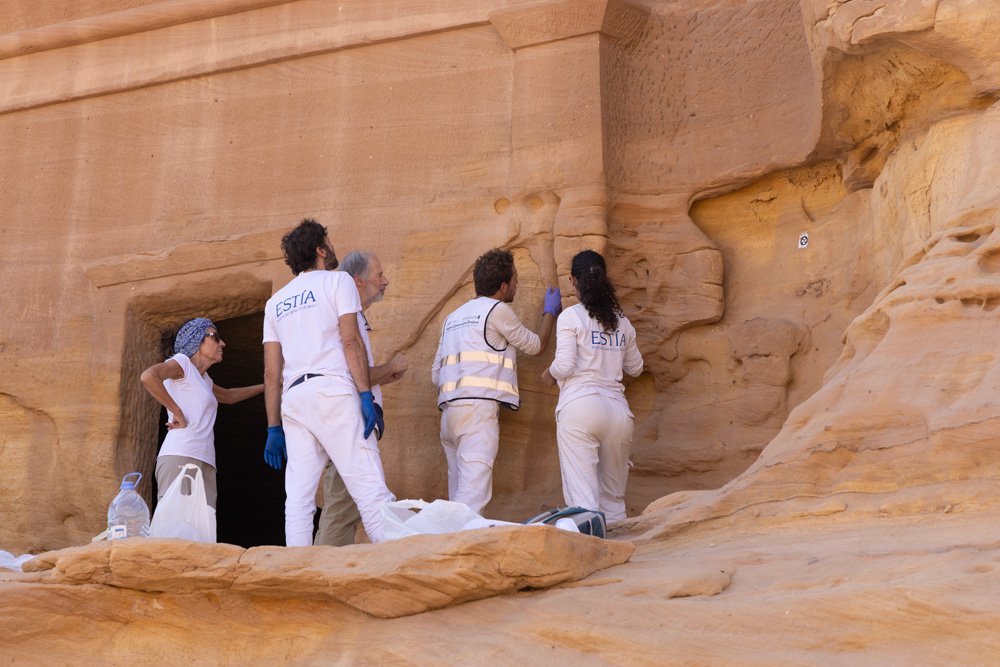
With October came our return to Hegra—and with it the beginning of the third and final field season of the project. This first month has already been intense and technically rich. A major focus has been on refining consolidation strategies, continuing the work initiated in previous seasons. Various forms of degradation are being addressed by re-establishing both adhesion and cohesion in the affected areas. As before, these tests are carried out on specifically identified “representative areas”—carefully selected zones whose characteristics mirror challenges found across the wider site. By concentrating our trials in these controlled test areas, we ensure that any successful method can later be replicated in similar contexts throughout Hegra.
Grouting operations have also resumed, using the formulations selected in previous seasons. However, the chromatic variability of Hegra’s sandstone remains a constant challenge: its shift in colour from one zone to another means that a single grout type is never sufficient. Each intervention requires a tailored mix to harmonise with the surrounding stone and maintain visual coherence. Alongside these activities, we continued our ongoing tests for the removal of biological deterioration agents, while also preparing small chromatic integration samples to evaluate final visual outcomes.
Throughout all of this, the GIS remains an active companion to our daily work. We are not only documenting interventions as they occur, but also collecting post-treatment measurements that will be compared with pre-treatment data. This side-by-side evaluation will be crucial for understanding the real efficacy of each operation and for defining the final conservation guidelines. The rhythm is fast, the tasks are many, but everything is now moving toward the final synthesis of three years of research and field practice.
Behind the Camera: Filming the Project Documentary
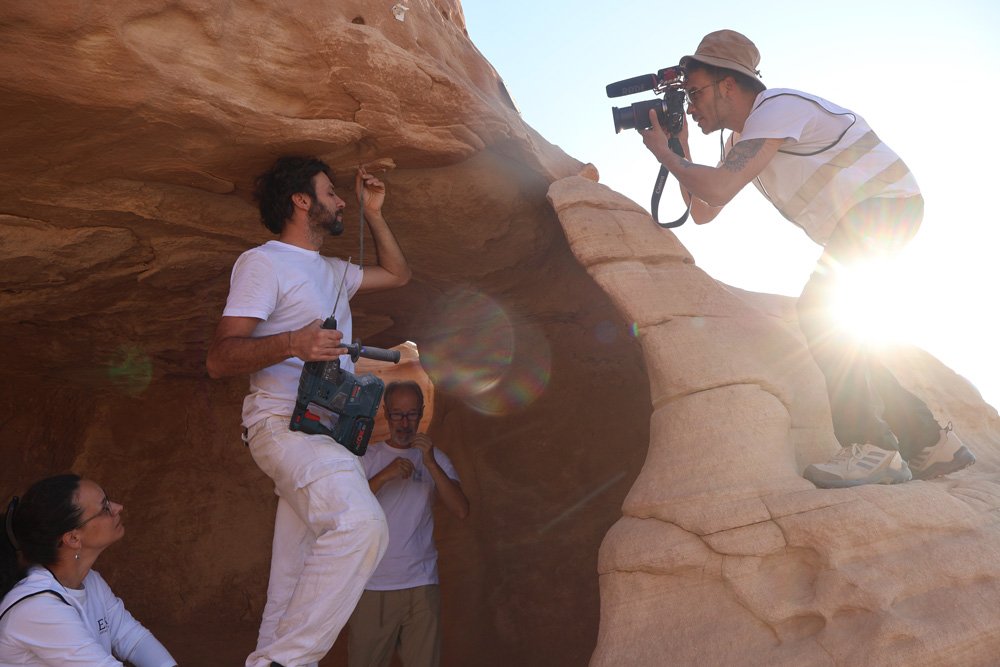
This season has also brought a new and rather unexpected companion to our days: the camera. Alongside our technical work, we have begun filming the documentary that will narrate the full arc of this three-year conservation project. With a small but determined team, we’ve recorded scenes of daily routines, conservation procedures, measurements, sand washing and sieving, and the many behind-the-scenes details that shape our work at Hegra.
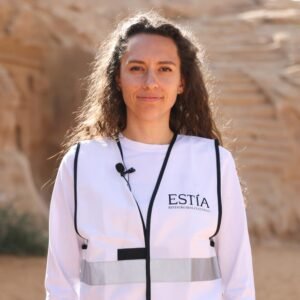
Several key interviews have already been filmed, each offering a different perspective on the project: the owner of the company reflecting on the broader vision; the site manager discussing the delicate balance between the natural environment and the man-made; our consolidation specialist addressing the technical challenges of the work; and myself tracing the long path of data transmission and GIS documentation that has accompanied the project since its earliest days. Meanwhile, the rest of the team has been followed during their day-to-day activities, giving the documentary a dynamic and authentic feel.
Parallel to the official content, some lighter and unexpected moments have also made their way onto the camera—clips that might one day form a humorous “behind the scenes” reel for internal memories. The final goal, however, is clear: to create a film for public outreach that brings together heritage, science, and the people behind the project. Through these images, we hope to share not only what we do, but also the dedication, curiosity, and teamwork that have carried this project forward season after season.
A Sunset Ride and a Lesson in Hospitality
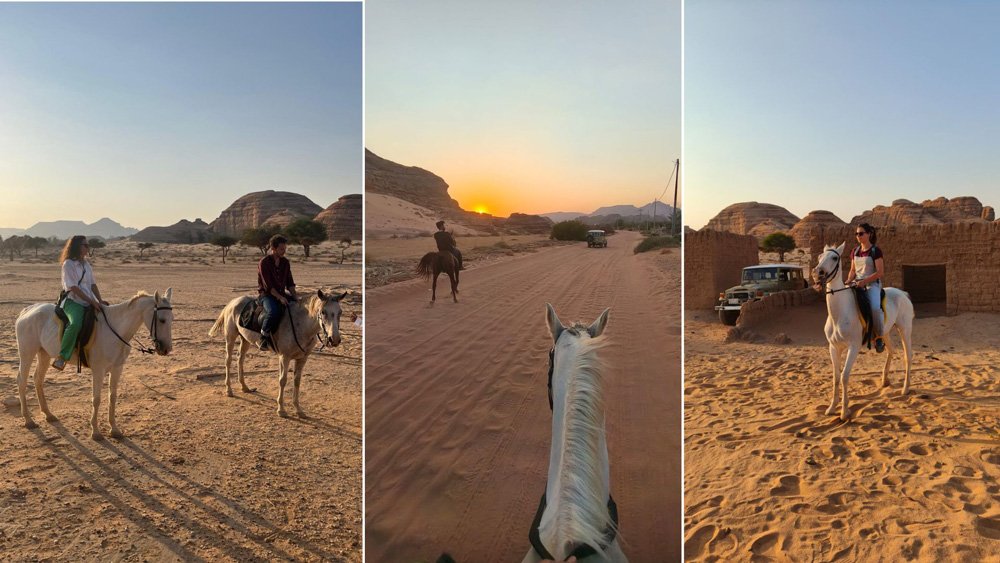
As the pace of work settled into its usual intensity, an unexpected encounter offered us a moment of genuine connection beyond the boundaries of the project. One afternoon, while simply looking for some batteries in a local shop, we struck up our first conversation with a young man whose kindness quickly transformed into an invitation: a horseback ride at his family’s farm behind Hegra. Needless to say that we accepted without hesitation. That evening, as the sun dipped toward the horizon, we rode through the desert among towering massifs, clusters of mud-brick houses, and quiet goat farms. The shifting light—turning the sandstone from gold to rose to deep amber—made every step feel like riding through a living painting.
What stayed with us even more than the landscape, however, was the hospitality. Our host, joined by his cousins and later by his father, welcomed us with a generosity that felt both spontaneous and deeply rooted. With the son translating from Arabic to English, we shared stories about our months in Saudi Arabia, reflections on the culture of hospitality that has marked our stay, and the surprising closeness between our traditions. They offered us dates, Arabic coffee, and a traditional sweet made with goat fat—simple gestures that carried the warmth of a long-standing custom. It was a reminder that while our days at Hegra are shaped by stone, data, and conservation methods, the most memorable moments often come from the people who quietly open a door into the life of this place.